Kick-off-Konferenz "Eastern Europe’s Invisibilities: Epistemics, Politics, Arts"

Department of Slavic and Eastern European Studies
The University of Zurich is establishing the Department of Slavic and Eastern European Studies (ISOS) to strengthen interdisciplinary research on Eastern Europe. This new interdisciplinary institute specializes in the analysis of contemporary historical, cultural, social, linguistic, and political developments across Eastern, East-Central, and South-Eastern Europe, the Caucasus, and Central Asia. The international conference “Eastern Europe's Invisibilities: Politics, Epistemics, Arts” will officially celebrate the opening of the ISOS in spring 2026.
Organizers: Prof. Dr. Tomáš Glanc, Prof. Dr. Botakoz Kassymbekova, Dr. Matthias Meindl, Prof. Dr. Jeronym Perović, Prof. Dr. Sylvia Sasse, Dr. Florian Wandl
Inaugural Conference of the interdisciplinary Institute for Slavic and Eastern European Studies (ISOS) at the University of Zurich, May 6th to 8th, 2026
Invisibility is a political condition of public non-presence. It can be both a product of power and a situation of powerlessness. What is visible to one may be invisible to another—and vice versa. Overlooking, just as much as seeing, is a capacity of power and an ethical practice. Noticing abuse and other forms of violence is both a cultural and individual act, shaped by social and political forces. Historically, the humanities have striven to bring to light the techniques of power, thus enabling ethical reconsideration and societal self-reflection.
Key questions of the conference on Eastern Europe’s Invisibilities include: How is invisibility produced, overcome, and experienced—and what does it mean for Europe’s East and Eastern European studies? How do Eastern European perspectives help us better understand current political transformations, and how might they offer insights for shaping positionality amid disinformation and increasing authoritarianism? What emancipatory responses do Eastern European studies offer to post- and de-colonial thought and vice versa?
The liberation from the dictatorships in 1989 and the related opening of the archives, in particular the partial opening of the secret service archives, and Russia’s full-scale invasion of Ukraine, have made invisibilities visible within research in a variety of avenues. But what exactly makes the perspectives of the viewers change, how are facts reframed and visions reshaped, and what are the preconditions for these changes? Who have been the producers of invisibilities? What made those invisibilities perceptible for some and invisible for others? What are the active practices of making something or someone invisible?
When are invisibilities products of violence, and when are they strategies of power(lessness) or resistance? What role do the arts and humanities play in the undoing and analysis of invisibility?
Day 1
May 6, 2026
Aula, KOL-G-201
University of Zurich, Rämistrasse 71, 8001 Zurich
Time |
Title |
| 15:00 | Welcome Address Prof. Dr. Katharina Michaelowa (Dean of the Faculty of Arts and Humanities) |
| 15:15 | Introductory Remarks |
| 15:30-17:30 |
Panel I: Colonial Invisibilities in Eastern EuropeWith Manuela Boatcă (University of Freiburg), Mart Kuldkepp (University College London), Jasmin Mujanović (Western Balkans Center, Washington D.C.), and Botakoz Kassymbekova (chair). |
| From 18:15 | Keynote & Evening Recpetion |
|
Welcome Address |
|
| Keynote and Discussion with Dmytro Kuleba | |
| Apéro | |
Day 2
May 7, 2026
KO2-F-152
Karl-Schmid-Strasse 4, 8006 Zürich
Time |
Title |
|---|---|
| 09:45–11:35 |
Panel II Invisible Languages and SpeakersWith Tobias Alexander Herrmann (Universität Köln), Katrin Karl (University of Bern), Katharina Tyran (University of Helsinki), and Florian Wandl (chair). |
| 11:45 | Coffee Break |
| 12:15–13:15 |
Panel III: Invisible Academia: Of Pseudo-Science, Extinguished Research and Invisible UniversitiesWith Andrea Pető (CEU, Vienna), Balázs Trencsényi (CEU, Vienna & Invisible University), Katharina Gerund, and Julia Richers (tbc). |
| 13:15–14:45 | Lunch Break |
| 14:45–16:45 |
Panel IV: Civil Society, Social Movements, and (Invisible) ResistanceWith Mariam Bibilashvili (CEES–Fellow; Masaryk University, Brno), Jan Matti Dollbaum (University of Fribourg), Valentina Petrović (UZH), and Jeronim Perović (chair). |
| From 18:00 | Evening Program |
| Tschornobyl – Archiv der unsichtbaren Katastrophe. Swetlana Alexijewitsch im Gespräch mit Sylvia Sasse (UZH) and Philine Bickhardt Strauhof, Lavaterhaus, St. Peterhofstatt 6, 8001 Zürich |
|
| Open Air Apéro at Augustinerhof | |
Day 3
May 8, 2026
KO2-F-152
Karl-Schmid-Strasse 4, 8006 Zürich
Time |
Title |
| 10:00–13:20 |
Panel V: Negotiating (In)VisibilityWith Éva Forgács (University of Pasadena), Rasa Kamarauskaitė (University College London), Emese Kürti (Central European Research Institute for Art History, Budapest), Dorota Sajewska (University of Bochum), Tomáš Glanc & Matthias Meindl (chairs). |
| 13:20–14:45 | Lunch Break |
| 14:45–16:10 |
Panel VI: Secret Services and the Production of InvisibilityWith Andriy Kohut (Director of the Sectoral State Archive of the Security Service of Ukraine), Evgenija Lezina (Leibniz Center for Contemporary History, Potsdam), Ilija Trojanow (Vienna), Roman Horbyk & Sylvia Sasse (UZH, chairs). |
Thematic panels
Panel I: Colonial invisibilities in Eastern Europe
Foreign domination— whether direct colonial occupation or broader imperial ăinvasion of Ukraine caught much of the academic and policy world by surprise. How was the reality of Russian imperialism overlooked for so long? What practices of knowledge have produced this invisibility, and why has colonialism in Eastern Europe remained undertheorized? This panel interrogates the mechanisms that obscured Russian imperial domination and explores what a future decolonization in Eastern Europe should entail for Europe as a whole and beyond.
With Manuela Boatcă (University of Freiburg), Mart Kuldkepp (University College London), Jasmin Mujanović (Western Balkans Center, Washington D.C.), and Botakoz Kassymbekova (chair).
Panel II: Invisible Languages and Speakers
Language, as the primary means of human communication, exists in countless different shapes and forms, many of which are not usually part of public discourse. This panel intends to shed light on some of the less visible linguistic varieties in the broader context of Eastern Europe. In particular, it concerns the language of ethnic and/or social minorities and the challenges faced by their speakers.
With Tobias Alexander Herrmann (Universität Köln), Katrin Karl (University of Bern), Katharina Tyran (University of Helsinki), and Florian Wandl (chair).
Panel III: Invisible Academia: Of Pseudo-Science, Extinguished Research and Invisible Universities
With Andrea Pető (CEU, Vienna), Balázs Trencsényi (CEU, Vienna & Invisible University), Katharina Gerund, and Julia Richers (tbc).
Panel IV: Civil Society, Social Movements, and (Invisible) Resistance
In many Eastern European states, civil society is under pressure. In Russia, organized civil society has mostly disappeared from political life, yet it occasionally reemerges in supposedly non-partisan issues, such as environmental protests. Serbia, in contrast, has witnessed a wave of citizens’ protests—no longer are young people alone filling the streets of Belgrade and other cities in open defiance of the government, but protesters of all ages and social backgrounds; still, many citizens remain silent or allow themselves to be recruited for mass demonstrations of support for the regime. Georgia, once renowned for its vibrant civic sphere, exemplifies the gradual decline of democracy, where civil society must now reorganize and carve out new spaces of resistance against an increasingly repressive state. Assembling these cases, the panel will show civil society as a contested space that shifts between the public visibility of popular discontent, enforced silence, and new ways to channel rebellion against repressive state power.
With Mariam Bibilashvili (CEES–Fellow; Masaryk University, Brno), Jan Matti Dollbaum (University of Fribourg), Valentina Petrović (UZH), and Jeronim Perović (chair).
Panel V: Negotiating (In)Visibility
The panel examines how communities on the short end of hegemonic power relations develop (in)visibility and agency below a threshold of full-volume activism. The panel dedicates itself to LGBTQA+ minorities in post-Soviet republics, targeted by the so-called anti-Gender campaigns of the populist right, as well as to the activities of artistic underground communities across Eastern Europe and Central Asia that have been marginalized by state and broader systemic censorship, as well as mainstream narratives of art historiography. It discusses attempts of self-assertion that duck the blows of full-contact political confrontation but still introduce new stitch patterns into the fabric of society. It also explores dominant interpretative patterns within and outside the respective communities that reproduce invisibilities—of artistic, political, gender-specific, geographical, and other positions—and thus generate through entrenched narratives “invisibility squared”.
With Éva Forgács (University of Pasadena), Rasa Kamarauskaitė (University College London), Emese Kürti (Central European Research Institute for Art History, Budapest), Dorota Sajewska (University of Bochum), Tomáš Glanc & Matthias Meindl (chairs).
Panel VI: Secret services and the production of invisibility
Secret services depend on invisibility. Although they operate in the visible realm, they do so incognito, present, yet invisible to the general public. Research in the former secret service archives of Central, Eastern, and South-eastern Europe has shown how these “regimes of invisibility” control multiple and multidirectional repression: authoritarian, to suppress their own critical populations; imperial, to enforce Russian interests in the party dictatorships of Eastern Europe; patriarchal, to criminalize feminist or transgender perspectives. In the panel, we will discuss different strategies of invisibilization by secret services in Eastern Europe.
With Andriy Kohut (Director of the Sectoral State Archive of the Security Service of Ukraine), Evgenija Lezina (Leibniz Center for Contemporary History, Potsdam), Ilija Trojanow (Vienna), Roman Horbyk & Sylvia Sasse (UZH, chairs).
Accompanying program
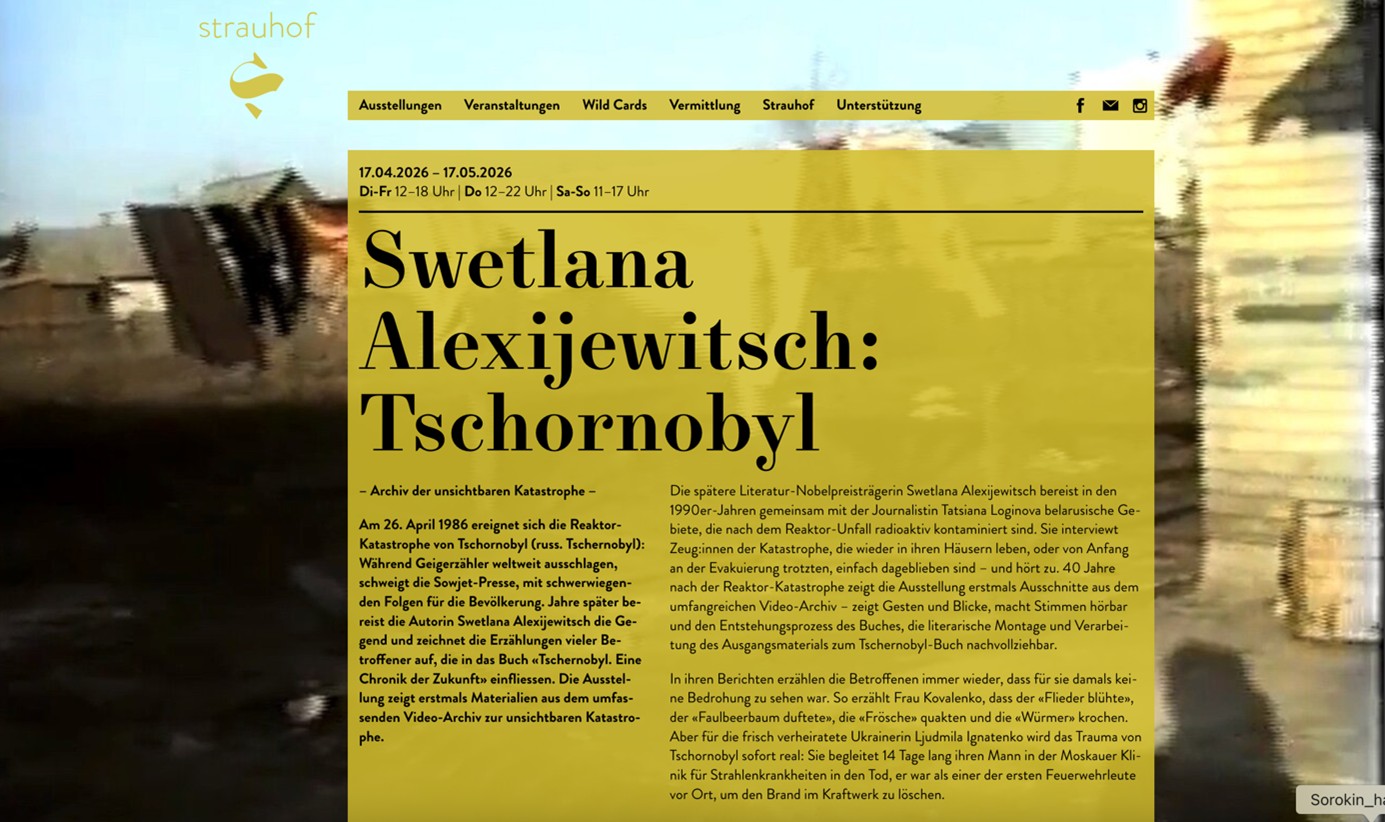
Exhibition: Swetlana Alexijewitsch: Tschornobyl – Archiv der unsichtbaren Katastrophe on https://strauhof.ch/ausstellungen/tschornobyl/